with blogging?

Blog. B-l-o-g. Bllllllog. B-log. The word comes from web-log. Did you know that? I did not.
But if I'm going to have a "blog", I should know better, so lets set some goals for this post.
Post Goals
- Understand how blogs came to be.
- Describe the current blog landscape
- Find out what makes a good blog.
The first blog
There are hundreds of articles online detailing the history of blogging. Google is quick to brag about having 729 million results when performing this query. However, as per usual, that number is clearly inflated - it doesn't take long before the results are hardly relevant. I took a little journey anyway. The most interesting result being on page 17; a link to the James Webb Space Telescope blog (https://science.nasa.gov/mission/webb/). Why is it the most interesting? Well, Space is cool, space telescopes are cool (definitely a topic for a future post), and while it's neat that "Webb's blog" almost has three b's in a row - it's also very close to the original term, weblog.
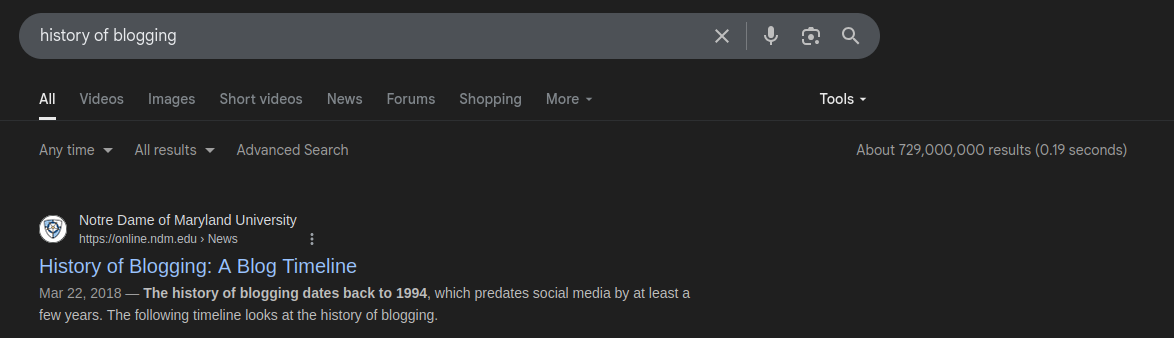
I could write another article about the history of blogging, maybe I'd make it to page 16 (that'd still put me in the top 0.00003% of results - or the 99.99997th percentile - not bad!). I have an idea that sounds a little more fun: let's go explore one of the very first blogs together.
Justin's links - links.net


The first blog?
This page is widely reported to be one of the first blogs. The domain name, links.net, gives us a hint as to what got this guy excited in the beginning - I'll get to that. What's maybe the most impressive about his site is that he still posts. He has been posting on his blog for over 31 years. That's a year longer than I've been breathing air; I'm pretty good at breathing by now, so I'd imagine he is at least as good at blogging. Reading and clicking through his page proves that to be... true..ish.
What do I mean by that? Well, if you spend enough time on links.net you will find something that will surprise you. I promise. Go ahead, click around on it (but please be a little bit careful - don't say I didn't warn you). The layout of the website is nowhere near apparent - at first glance it seems to be a labyrinth of links. Let's start at the beginning (afterall, I'm supposed to be finding out how blogs came to be. That's what I promised you). There's so much to unpack.
-
First of all, this guy was very excited about "HyperText" and the "World Wide Web". HyperText itself wasn't a new concept, around since the '60s, but HTTP (HyperText Transfer Protocol), developed by Tim Berners-Lee was recently released (1991). You've probably heard of him before? Known as the founder of the internet, or more specifically the WorldWideWeb, W3, WWW, however you want to call it.
-
One of the things I find fascinating that reveals a huge difference between the web then and now: his "link of links" page. Today we are entirely reliant on search engines. Well, we were, now LLM's are starting to take hold - that's a blog topic for another day. But back then it was common for people to have pages of links to websites they liked or found cool and wanted to share. And this was a primary way of, "surfing" the web, hopping from links, to lists of links, to more links. In Justin's words:
A good search engine will surf for you, but don't think that cuz they don't find it, it ain't out there. You often got to start at one site and work your way into the hidden, uncatalogued gems. ~Justin hall
-
This one is kind of an aside - but clicking around his site I eventually came across the "the first www page". You can even access it using a simulator that simulates the experience of the first widely available web browser - a line mode browswer. I had never come across this before, so I got a little giddy when I found it.
I've could go on and on about his page, but I'll let you explore. Those were my immediate observations. Again, if you want a more in depth history of blogging, there are ton of articles on it. But before we move on to the next topic, I want to share with you an actual article on the history of blogging, by Rebecca Blood. I mean, it was written in 2000, so doesn't even cover two thirds of all blogging history, but it's absolutely worth reading if you find the time.


Maybe I just liked it so much because of this one excerpt:
The blogger, by virtue of simply writing down whatever is on his mind, will be confronted with his own thoughts and opinions. Blogging every day, he will become a more confident writer. A community of 100 or 20 or 3 people may spring up around the public record of his thoughts. Being met with friendly voices, he may gain more confidence in his view of the world; he may begin to experiment with longer forms of writing, to play with haiku, or to begin a creative project--one that he would have dismissed as being inconsequential or doubted he could complete only a few months before.
As he enunciates his opinions daily, this new awareness of his inner life may develop into a trust in his own perspective. His own reactions--to a poem, to other people, and, yes, to the media--will carry more weight with him. Accustomed to expressing his thoughts on his website, he will be able to more fully articulate his opinions to himself and others. He will become impatient with waiting to see what others think before he decides, and will begin to act in accordance with his inner voice instead. Ideally, he will become less reflexive and more reflective, and find his own opinions and ideas worthy of serious consideration.
I have started this blog because I want to be more thoughtful about how I learn about different topics, but also to improve my writing. However, after reading the above, I am updating my motivations to include becoming more reflective and therefore confident in my own thoughts. With constant inundation and stimulation of shorts and news, this can't be a bad thing.
Current blogging landscape
I'll be honest with you, this question doesn't excite me as much. But, I'll start with numbers, I love numbers - who doesn't love numbers. You might think "who blogs anymore? anyone who's anyone on the internet is on instagram... right?". Well, you're wrong (but also maybe instagram is kinda a blog... kinda). Blogs come in so many shapes and forms. Some facts (and yes, another history of blogging article) from webtribunal.net:
- More than a third of all websites are blogs
- Tumblr hosts the vast majority of blogs with 518 million
- WordPress, for all its fame and widespread adoption, is a distant second with 60 million.
- More than 6 million posts go live every day, on average.
I was interested to see how Ghost, the platform I am using, stacked up. Ghost has 22,000 active customers, and an estimated 5000 self-hosted users (I am one of those ~5000). So small pickings for Ghost. But when I make this post, it will be one of the 6 million that day!
A lot of blogging these days seems to be for the purposes of search engine optimization. Many businesses have blogs to increase traffic to their websites. Increased traffic, and more words and links on your website also will increase its chances of showing up in someone's web search.
There's a lot more someone could say about this topic, but I'm choosing not to, primarily because of what my answer is for the last topic.
What makes a good blog
To know what makes a blog good, you have to consider what is the reason the person is blogging. This could be personal growth, social interaction (for some blogs like tumblr), building an internet presence, search engine optimization for a business, or just to straight up make money. The platform I am blogging on has the ability for paywalls - you're lucky because you are getting all of these premium content for FREE! Anyway, the reasons are diverse, and therefore what will make a blog good is probably also diverse - aside from the obvious rules such as "well written", "interesting topics". Here are a few rules I'll posit:
- The writer should be interested in the topic. This is why I chose not to continue to write about the last topic. A business oriented blog might not have such a luxury, but I'm sure it shows when someone is not enjoying writing about something.
- The blog should provide value to at least one of the writer and the reader. I think for a personal blog, the former is probably more important.
- The blog that is written is always better than the one that is not.
So that's whats going on with blogging! This post is what my brain came up with for this topic, and that's ok. Stay tuned.